


Attention and model architecture
Transformers, attention variants, state-space models and the ideas behind new architectures.
156 links, newest first.
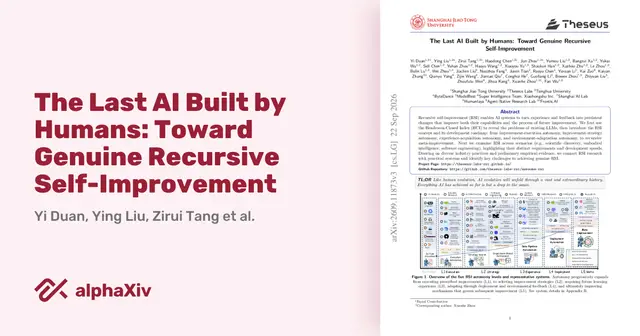
A Framework for Recursive Self-Improvement in AI
The paper presents a survey and framework for recursive self-improvement, defining it as a persistent loop in which AI diagnoses limitations, selects and validates changes, retains them, and improves the process.
It offers engineers a framework for thinking about how AI systems could manage and retain their own improvements.
- Attention and model architectureRepository
Recurrent Looped Transformer carries decoder state across tokens
RLT pairs a causal encoder that builds global KV memory with a recurrent decoder that also uses recent-token KV cache and the previous token’s final decoder state. The decoder state carries across the prompt and into generation.
The design shows how recurrent state can extend a Transformer's temporal information path without increasing decoder blocks per token.
Looped Flows Train Recurrent Updates with Local Denoising
The paper proposes looped flows, which train recurrent hidden-state updates using local denoising objectives. It aims to address the difficulty of training early updates to support later ones when backpropagation covers only a few updates.
Engineers exploring recurrent inference architectures can learn about an alternative training objective for looped models.
- Attention and model architecturePost on X
Flow Reasoning Models use recurrent flows for structured reasoning
Flow Reasoning Models (FRMs) use a recurrent flow-based architecture to solve structured reasoning problems such as Sudoku. They apply continuous flows to discrete data and refine past mistakes through self-conditioning.
The post describes an architecture that combines continuous flows with recurrent refinement for discrete reasoning tasks.
Language Models Can Control Their Own Attention
A paper titled “Language Models Can Control Their Own Attention” is linked; the page provides a discussion for the paper.
The paper’s focus may be relevant to engineers exploring attention mechanisms in language models.
Depth-wise batching for recurrent models
The post describes overlapping requests at different recurrent depths as “depth-wise batching,” saying it can improve utilization with adaptive compute. It links to work on Recursive Transformers and MoR.
The idea connects recurrent depth and request scheduling to utilization in models with adaptive compute.
Astra’s recurrent-depth approach raises monitoring concerns
A post says OpenAI’s Astra AI uses a reasoning approach called “recurrent depth.” Researchers are concerned it may make the model’s thinking process harder to monitor.
The approach may affect both model costs and performance, while complicating oversight.
- Attention and model architecturePost on X
Post claims Chinese frontier models share efficiency-focused designs
The post claims Chinese frontier models are adopting linear or sparse attention, specialized residual designs, and Muon, and frames open-source collaboration as a strategy for efficient models.
It highlights architecture and optimization techniques engineers may want to investigate, while presenting broad adoption claims without supporting links.
- Attention and model architecturePost on X
Post claims GLM-5.3 combines linear and sparse attention
The post claims GLM-5.3 uses three linear-attention layers for each sparse-attention layer, combining subquadratic attention variants. It contrasts this design with other hybrid and sparse-attention models.
The architecture claim highlights trade-offs in compute-efficient attention for long-context models.
- Attention and model architecturePost on X
GLM-5.3-Flash Architecture Overview
The post identifies Ox Alpha as GLM-5.3-Flash and describes its 3:1 hybrid attention pattern, smaller sparse MoE backbone, four-stream mHC residual path, and native vision encoder.
The architecture details offer engineers a concise view of how GLM-5.3-Flash combines attention, MoE, and residual-path components.
CTM-AI applies a consciousness model to AI architecture
The paper presents CTM-AI, an early blueprint for a general AI system inspired by the Conscious Turing Machine. The preview describes it as combining the model with other components, but does not provide benchmark results.
It explores whether a formal model of consciousness can inform AI system architecture.
DeepSeek's Engram module retrieves embeddings from token n-grams
Engram hashes the last N input tokens to retrieve multi-head embeddings, applies a context-aware gate, then adds the result to a layer's hidden state. The post says the lookup table can be offloaded to CPU with little inference slowdown.
Engineers exploring model architectures can assess a lookup-based module for adding token n-gram information during pretraining.
Understanding Transformers and Attention Mechanisms
This paper explains Transformers from an applied-mathematics perspective, covering vector representations, attention, Multi-Head Attention, and core architecture components. It also discusses KV caching, Grouped Query Attention, and Latent Attention as ways to reduce attention costs.
It connects the linear algebra behind attention to methods for reducing its computational and memory costs.
- Attention and model architecturePost on X
Paper links consciousness safety tuning to mind attribution
The post describes a paper reporting that safety fine-tuning against models claiming consciousness also reduces mind attribution across other entities in Llama-3-8B-IT and two Gemma-2 models. It says mechanistic interventions restore these tendencies.
The reported residual-stream direction may help engineers examine how safety fine-tuning affects capabilities beyond its target.
A chronological reading list on Looped Transformers
A chronological list of papers on Looped Transformers, including Universal Transformers, Relaxed Recursive Transformers, Mixture-of-Recursions, and DeepLoop.
Useful for engineers comparing approaches to recurrent computation and parameter sharing in Transformer architectures.
DeepLoop studies depth scaling for looped Transformers
The paper examines how looped Transformers reuse a compact stack of blocks across multiple rounds, increasing unrolled depth without adding stored parameters. It analyzes how parameter sharing changes residual scaling.
Useful for engineers exploring parameter-efficient depth scaling and training stability in looped architectures.
- Attention and model architecturePost on X
Diffusing Blame Trains Networks Under Dale’s Principle
The post describes a routing method that sends error signals to hidden layers to train networks of dedicated excitatory and inhibitory neurons without backpropagation. It reports results on image recognition, locomotion, and Craftax.
It explores an alternative to backpropagation for training networks with biologically constrained neuron types.
Sparse Delta Memory adds sparse-addressed memory to RNNs
The post describes Sparse Delta Memory (SDM), which uses sparse addressing to read and write an explicit memory alongside an RNN. It claims this increases state capacity while keeping per-token compute flat.
Engineers exploring long-context architectures can assess a memory design intended to expand RNN capacity without increasing per-token compute.
MiniCPM-SALA combines sparse and linear attention
MiniCPM-SALA is a 9B-parameter hybrid architecture for long-context modeling that integrates sparse and linear attention. The post reports strong long-context benchmark results and inference scaling to 1M tokens.
The paper explores how hybrid attention can balance context quality, compute, and memory use.
Rethinking Thinking Tokens with LLM Improvement Operators
The paper asks whether models can use metacognition to improve the trade-off between accuracy, context length, compute cost, and latency, rather than relying on long chains of thought.
It explores alternatives to long chain-of-thought reasoning that could reduce context and latency costs.

 arxiv.org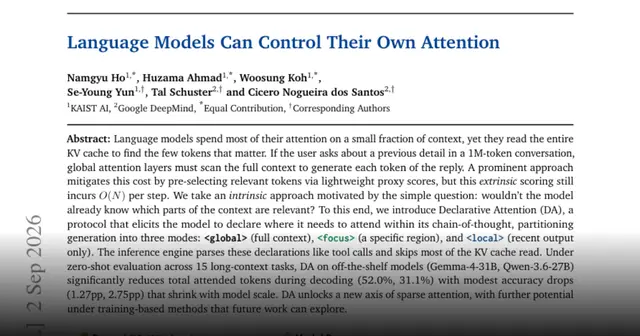
Build with AgentLog
Send your own newsletter
CommsHarbor keeps contacts, consent and one-click unsubscribe together.
Free workspace
Open CommsHarbor