


RAG and retrieval
Chunking, embeddings, rerankers, evaluation and what holds up in production.
66 links, newest first.
- RAG and retrievalRepository
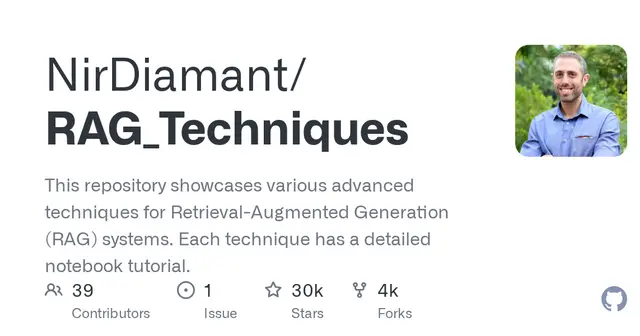
GitHub repository of RAG technique tutorials
The RAG_Techniques repository provides notebook tutorials on retrieval-augmented generation, covering approaches such as reranking, chunking, filtering, and Graph RAG.
Engineers can use the notebooks to explore a range of RAG techniques.
- RAG and retrievalPaper
LightRAG combines graph indexing with dual-level retrieval
LightRAG is a RAG framework that uses graph-based text indexing and low- and high-level retrieval to handle entity-specific and conceptual information.
Engineers can explore graph-based indexing as an approach to complex queries and incremental data updates.
- RAG and retrievalArticle
A roundup of five recent RAG papers
This roundup lists five papers on RAG, including work on metadata and synthetic QA, modular research frameworks, graph RAG, fact-checking, and weakly supervised dense retrieval. Its preview says metadata-augmented queries improve retrieval and answer quality.
Useful for engineers tracking research directions across retrieval methods and RAG system design.
- RAG and retrievalPaper
EfficientRAG for Multi-Hop Question Answering
The paper introduces EfficientRAG, an efficient retriever for multi-hop question answering. It iteratively generates new queries without requiring an LLM call at every iteration.
It describes a retrieval approach aimed at reducing repeated LLM calls for complex questions.
- RAG and retrievalPost on X
sqlite-vec adds vector search to SQLite
sqlite-vec is a dependency-free SQLite extension written in C for vector search. The post lists support for multiple distance metrics, quantization, embedding integrations, and SDKs for several languages.
It may suit engineers exploring local or on-device vector retrieval with SQLite.
- RAG and retrievalPost on X
Baidu’s self-reasoning framework for RAG
The framework has an LLM assess retrieved-document relevance, select and cite evidence snippets, then analyze those reasoning trajectories to produce an answer. The post says it achieves performance comparable to GPT-4 with 2K GPT-4-generated training samples.
Its relevance and evidence-selection steps offer engineers a concrete approach to making RAG answers more traceable.
 arxiv.org
Build with AgentLog
Send your own newsletter
CommsHarbor keeps contacts, consent and one-click unsubscribe together.
Free workspace
Open CommsHarbor